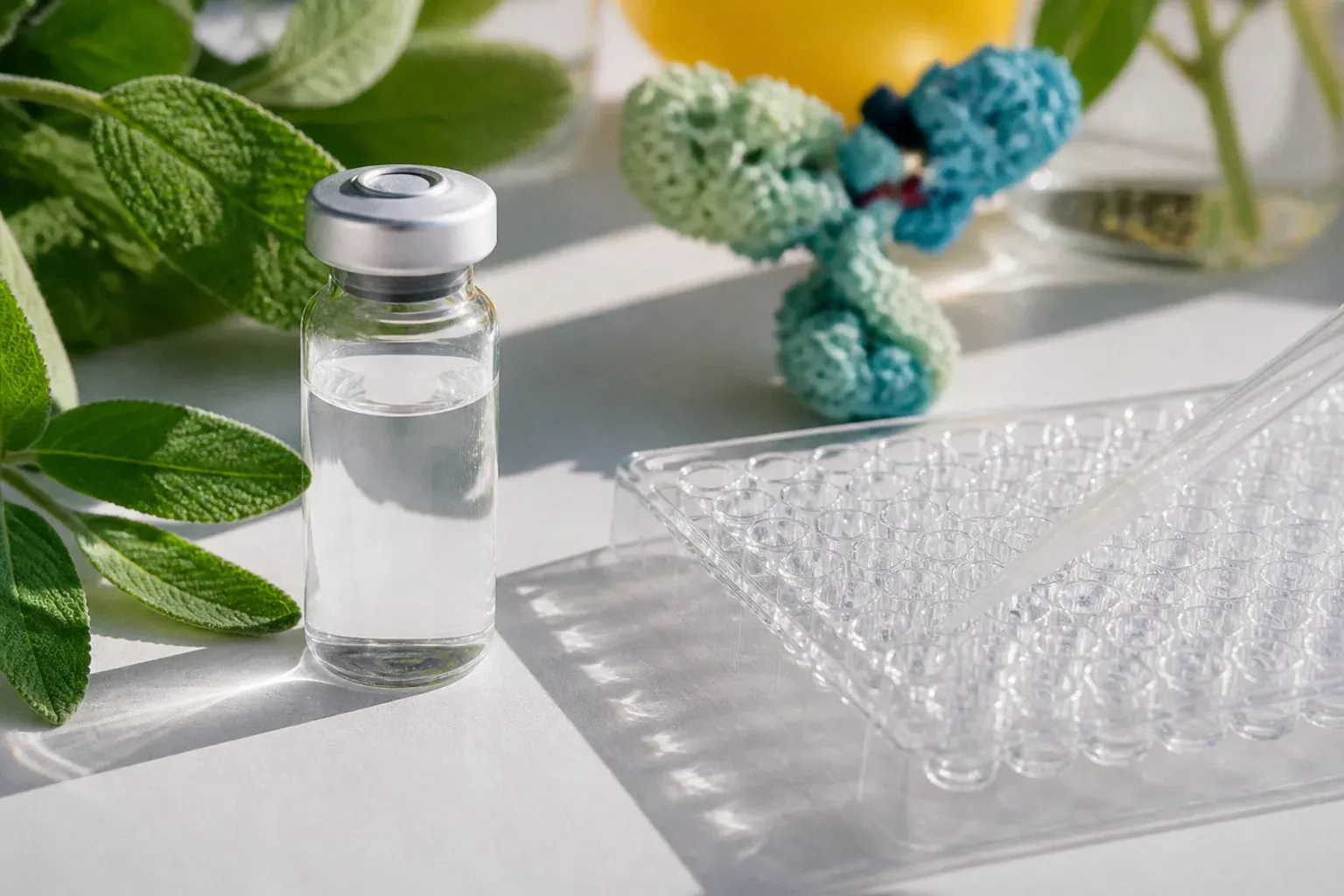
Can your body build immunity to a GLP-1 medicine? It can make GLP-1 anti-drug antibodies, and with some drugs most people do. In the Zepbound weight trials, 64.5% of people on tirzepatide developed antibodies to it. What the trial data have not shown is the thing people fear most: antibodies quietly switching the medicine off.
The question comes up because GLP-1 drugs are peptides, short chains of amino acids injected under the skin, and the immune system sometimes treats injected peptides as foreign. When a weight plateau arrives, an antibody explanation sounds plausible. The research separates three things that often get lumped together: antibodies that bind the drug, antibodies that block it, and antibodies that cause reactions at the injection site.
This article walks through how often each GLP-1 drug triggers antibodies, which of those antibodies are neutralizing, what happened to blood sugar and weight in antibody-positive patients, and what is still unknown about low doses and compounded products.
Key Takeaways
- Anti-drug antibody rates vary widely by GLP-1 medicine, from 1.6% on dulaglutide to 64.5% on tirzepatide in its weight reduction trials (Zepbound label, 2026).
- Neutralizing antibodies are rare: on the Zepbound label they blocked tirzepatide at the GIP receptor in 2.8% of patients and at the GLP-1 receptor in 2.7%.
- A Lilly analysis of 5025 SURPASS patients found tirzepatide antibodies had no effect on drug levels or efficacy (Mullins, Journal of Clinical Endocrinology and Metabolism, 2024).
- Semaglutide antibody rates rose from 3% to 11.2% at the same 2.4 mg dose when Novo Nordisk switched to a more sensitive assay, so rates from different tests cannot be compared directly.
- Antibody-positive tirzepatide users had more injection site reactions: 11.3% compared with 1% of antibody-negative users.
- No study has measured anti-drug antibodies at microdoses or in compounded GLP-1 users.
What are GLP-1 anti-drug antibodies?
Binding, cross-reacting and neutralizing
GLP-1 anti-drug antibodies are immune proteins that recognize and bind a GLP-1 medicine. Regulators require every peptide drug to be tested for them, and the results sit in a section of each prescribing label called Immunogenicity. Most anti-drug antibodies are binding antibodies: they attach to the drug but leave its active site free.
Two smaller subgroups matter more. Cross-reactive antibodies also recognize the body's own hormones, native GLP-1 and, for tirzepatide, native GIP. Neutralizing antibodies block the drug from switching on its receptor. A neutralizing antibody is the kind that could, in principle, blunt a drug's effect, and a cross-reactive neutralizing antibody could also interfere with the natural hormone.
Labels also carry a warning about the numbers themselves. Both the Wegovy and Zepbound labels state that the observed incidence of anti-drug antibodies is highly dependent on the sensitivity and specificity of the assay. A drug tested with a sensitive assay will look more immunogenic than one tested with a blunt one, even if the immune response is identical.
How common are antibodies to semaglutide, tirzepatide and other GLP-1s?
Prescribing labels and pooled trial analyses
Antibody rates range from under 2% to nearly two thirds of patients, depending on the drug. Dulaglutide sits at the low end: across 9 phase II and III trials with 4006 dulaglutide-treated patients, Milicevic and colleagues found 1.6% tested positive, against 0.7% in the non-GLP-1 comparator groups. In the LEAD trials, 8.7% of patients on liraglutide 1.2 mg and 8.3% on 1.8 mg had low-level antibodies after 26 weeks (Buse, Journal of Clinical Endocrinology and Metabolism, 2011).
Semaglutide shows how much the assay matters. On the Wegovy label, 50 of 1709 patients (3%) on 2.4 mg developed antibodies over 68 weeks. With a newer assay in later trials, 11.2% of patients on 2.4 mg and 15.4% on 7.2 mg tested positive over 72 weeks. The dose did not triple the immune response; the test got better at finding it.
Tirzepatide and exenatide sit at the high end. In 5025 people with type 2 diabetes across 7 SURPASS trials, 51.1% developed treatment-emergent antibodies to tirzepatide. In the Zepbound weight reduction studies, the figure was 64.5% (1591 of 2467), and 60.6% in the sleep apnea studies. Exenatide, the first drug in the class, produced antibodies in 36.7% of twice-daily users at 30 weeks and 56.8% of once-weekly users at 24-30 weeks. For a wider comparison of the two newer drugs, see our guide to semaglutide vs tirzepatide.
How Often Does Each GLP-1 Trigger Antibodies?
Percent of treated patients who tested positive for anti-drug antibodies. Assays and trial lengths differ, so cross-drug comparisons are rough.
Milicevic Z et al. 2016 (dulaglutide); Wegovy prescribing information, 2026; Buse JB et al. 2011 (liraglutide); Fineman MS et al. 2012 (exenatide); Mullins GR et al. 2024 (SURPASS); Zepbound prescribing information, 2026.
How many GLP-1 antibodies actually neutralize the drug?
Zepbound prescribing information, 2026
Very few. Tirzepatide has the most detailed public breakdown. In the Zepbound weight reduction trials, 64.5% of patients made some anti-tirzepatide antibody, 40% made antibodies that also recognized native GIP, and 16.5% made antibodies that also recognized native GLP-1. Only 2.8% had antibodies that neutralized tirzepatide at the GIP receptor and 2.7% at the GLP-1 receptor.
Antibodies that neutralized the body's own hormones were rarer still: 0.8% for native GIP and 0.1% for native GLP-1. In the sleep apnea trials, no tirzepatide-treated patient developed neutralizing antibodies of any kind.
The SURPASS analysis in type 2 diabetes found the same shape. Neutralizing antibodies against tirzepatide activity were seen in 1.9% of patients at the GIP receptor and 2.1% at the GLP-1 receptor, and fewer than 1.0% had cross-reactive neutralizing antibodies to the native hormones. For semaglutide, the Wegovy label reports cross-reactivity with native GLP-1 in 56% of the antibody-positive patients on the older assay and 8.8% on the newer one, and states that the clinical consequences of that cross-reactivity are unknown.
From Binding to Blocking: How the Numbers Shrink
Percent of tirzepatide-treated patients in the Zepbound weight reduction trials, by antibody type
Zepbound (tirzepatide) prescribing information, section 12.6, DailyMed, 2026.
Do anti-drug antibodies make a GLP-1 stop working?
Mullins 2024, Buse 2011 and Fineman 2012
For the newer drugs, the trial data show no loss of effect. Mullins and colleagues at Lilly analyzed antibody results from 7 SURPASS trials and reported that antibody status, antibody titer and neutralizing status had no effect on the pharmacokinetics or efficacy of tirzepatide, even though titers ranged from 1:20 to 1:81,920. The Zepbound label likewise reports no clinically significant effect on effectiveness.
Semaglutide has less data on this point. The Wegovy label reports no clinically significant effect of antibodies on drug levels, but says there is insufficient evidence to characterize their effects on safety or effectiveness. That is a statement of uncertainty, not a finding of harm.
Liraglutide antibodies were low-level and did not blunt blood sugar control in the LEAD trials: HbA1c fell 1.1-1.3% in antibody-positive patients and 1.2% in antibody-negative patients. Exenatide is the one GLP-1 where antibodies showed a measurable cost, and only at high levels, which the next section covers. Practical causes of a stalled response are far more common, and our article on weight loss plateaus on a GLP-1 walks through them.
What did exenatide teach researchers about high antibody titres?
Fineman and colleagues, Diabetes, Obesity and Metabolism, 2012
Exenatide showed that antibody level, not antibody presence, is what matters. Fineman and colleagues pooled 12 controlled twice-daily trials (n = 2225), 5 uncontrolled extensions running up to 3 years (n = 1538) and 4 once-weekly trials (n = 653). Most antibody-positive patients had low titres: 31.7% of twice-daily users and 45.0% of once-weekly users, against 5.0% and 11.8% with higher titres.
Overall, blood sugar responses were similar regardless of antibody status. Mean HbA1c changed by -1.0 and -0.9% in antibody-negative and antibody-positive twice-daily users, and by -1.6% and -1.3% in once-weekly users. In the higher-titre subsets, though, mean reductions were attenuated, and the link between rising titre and smaller benefit was statistically significant for the once-weekly form.
Two other findings are reassuring. The anti-exenatide antibodies tested did not cross-react with human GLP-1 or glucagon. And in the LEAD-6 trial, 61% of patients had anti-exenatide antibodies at week 26, yet switching them to liraglutide brought a further 0.4% HbA1c reduction. Antibodies to one GLP-1 did not block the next one.
Most Exenatide Antibodies Were Low Titre
Percent of patients with low-titre and higher-titre antibodies, twice daily at 30 weeks and once weekly at 24-30 weeks
- Low titre
- Higher titre
Fineman MS et al. Diabetes, Obesity and Metabolism, 2012. Pooled exenatide trial data.
Did Antibodies Blunt Blood Sugar Control?
Mean HbA1c change in percentage points, antibody-negative vs antibody-positive exenatide users
- Antibody-negative
- Antibody-positive
Fineman MS et al. Diabetes, Obesity and Metabolism, 2012.
Do GLP-1 antibodies go away over time?
The only long-term time course is for exenatide
With exenatide, they faded on continued treatment. Mean titres peaked early, between 6-22 weeks, and then declined. The share of twice-daily users who tested positive fell from 36.7% at 30 weeks to 16.9% at 3 years, and higher-titre antibodies fell to 1.4%. Among once-weekly users, positivity went from 56.8% at 24-30 weeks to 45.4% at 52 weeks.
Nobody has published a comparable multi-year curve for semaglutide or tirzepatide. Their labels report antibody status over the length of the main trials, 52 weeks or longer for Zepbound and 68 or 72 weeks for Wegovy. Whether their antibody levels also settle over years of use is an open question.
Exenatide Antibody Positivity Fell With Continued Use
Percent antibody-positive at an early and a later time point
- Early time point
- Later time point
Fineman MS et al. Diabetes, Obesity and Metabolism, 2012.
Can GLP-1 antibodies cause injection site or allergic reactions?
Where antibodies do show up clinically
Yes, this is where antibody status makes a visible difference. In the pooled Zepbound weight trials, injection site reactions occurred in 11.3% of patients with anti-tirzepatide antibodies and 1% of those without. The SURPASS analysis found the same pattern for both hypersensitivity and injection site reactions, and noted that most of these events were nonserious and mild to moderate.
For semaglutide, injection site reactions were reported in 1.4% of Wegovy-treated adults and 1% on placebo in the weight trials. Exenatide followed the same rule: apart from injection site reactions, adverse event rates were similar in antibody-positive and antibody-negative patients.
Serious reactions are rare but real. Both labels state that serious hypersensitivity reactions have been reported, and the Wegovy label names anaphylaxis and angioedema. Swelling of the face, lips or throat, hives that spread, or trouble breathing after a dose needs urgent care. Redness or a small itchy lump at the site is far more common, and our guide to injection technique, sites and storage covers the practical side.
Injection Site Reactions by Antibody Status
Percent of patients with injection site reactions in the weight reduction trials
Zepbound and Wegovy prescribing information, DailyMed, 2026. Tirzepatide figures split by antibody status; semaglutide figures are drug vs placebo.
Are compounded GLP-1s more likely to trigger antibodies?
Kopp and colleagues, Pharmaceutical Research, 2026
That has been raised in the laboratory but not measured in patients. Kopp and colleagues, all current or former Novo Nordisk scientists, tested follow-on and compounded semaglutide and liraglutide products against the originals. The products had distinct impurity profiles, including amino acid deletions and additions, and compounded semaglutide changed more than the originator when exposed to light.
In assays using immune cells from healthy donors, cells exposed to the impurities presented various potentially immunogenic peptides, and the authors concluded that the tested impurities pose increased immunogenicity potential. They stressed the importance of in vitro and clinical immunogenicity studies for these products.
Two cautions apply. The study was done by the originator's own scientists, and cell assays predict risk without measuring it. No clinical trial has reported antibody rates in people using compounded GLP-1s, so the size of any difference is unknown. Concentration and dosing errors with vials are a separate and better documented problem, covered in our article on compounded vials vs brand pens.
Does microdosing a GLP-1 change antibody risk?
What the evidence can and cannot support
No study has measured it. In the SURPASS analysis, the share of patients who developed tirzepatide antibodies was similar across the 5 mg, 10 mg and 15 mg groups, so within the approved range, dose did not change how often antibodies appeared. Doses below that range were never tested for immunogenicity.
The semaglutide numbers cannot answer the question either. The higher rate at 7.2 mg than at 2.4 mg came from the same newer assay, but the trials were not designed to test a dose-response for antibodies, and nothing in them covers doses well below 2.4 mg.
The honest summary is narrow. Antibodies to GLP-1 medicines are common, especially with tirzepatide, and they have not been shown to reduce the effect of tirzepatide, liraglutide or most exenatide users' treatment. They do raise the rate of injection site reactions. Whether a microdose or an irregular schedule changes any of this is unknown, and a prescriber who knows the full dosing history is the right person to judge a reaction or a lost response.
Frequently Asked Questions
References
- Mullins GR, Hodsdon ME, Li YG, et al. Tirzepatide Immunogenicity on Pharmacokinetics, Efficacy, and Safety: Analysis of Data From Phase 3 Studies. Journal of Clinical Endocrinology and Metabolism, 2024. doi:10.1210/clinem/dgad532
- Fineman MS, Mace KF, Diamant M, et al. Clinical relevance of anti-exenatide antibodies: safety, efficacy and cross-reactivity with long-term treatment. Diabetes, Obesity and Metabolism, 2012. doi:10.1111/j.1463-1326.2012.01561.x
- Buse JB, Garber A, Rosenstock J, et al. Liraglutide treatment is associated with a low frequency and magnitude of antibody formation with no apparent impact on glycemic response or increased frequency of adverse events: results from the LEAD trials. Journal of Clinical Endocrinology and Metabolism, 2011. doi:10.1210/jc.2010-2822
- Milicevic Z, Anglin G, Harper K, et al. Low incidence of anti-drug antibodies in patients with type 2 diabetes treated with once-weekly glucagon-like peptide-1 receptor agonist dulaglutide. Diabetes, Obesity and Metabolism, 2016. doi:10.1111/dom.12640
- Kopp KL, Lamberth K, Schelde O, et al. Impurities and Potential Immunogenicity Associated With Follow-on and Compounded Glucagon-like Peptide-1 Receptor Agonists. Pharmaceutical Research, 2026. doi:10.1007/s11095-026-04146-9
- Wegovy (semaglutide) prescribing information. Novo Nordisk. DailyMed, 2026. dailymed.nlm.nih.gov
- Zepbound (tirzepatide) prescribing information. Eli Lilly and Company. DailyMed, 2026. dailymed.nlm.nih.gov
This article is for general educational purposes only and does not constitute medical advice or a recommendation to start, stop or change the dose of any medication. Semaglutide, tirzepatide, liraglutide, exenatide, dulaglutide and other GLP-1 receptor agonists are prescription medicines, and microdose regimens are not an FDA-approved way of using GLP-1 drugs. The antibody data described here come from specific drugs, doses, assays and trial populations, and may not apply to other products or doses. Seek urgent care for signs of a serious allergic reaction. Nothing here is intended to diagnose, prevent, treat, or cure any condition.
Smaller Doses. Sharper Protocols.
Metabolic health you can measure, built around a dose designed to work with your body rather than against it.
Find Your Protocol