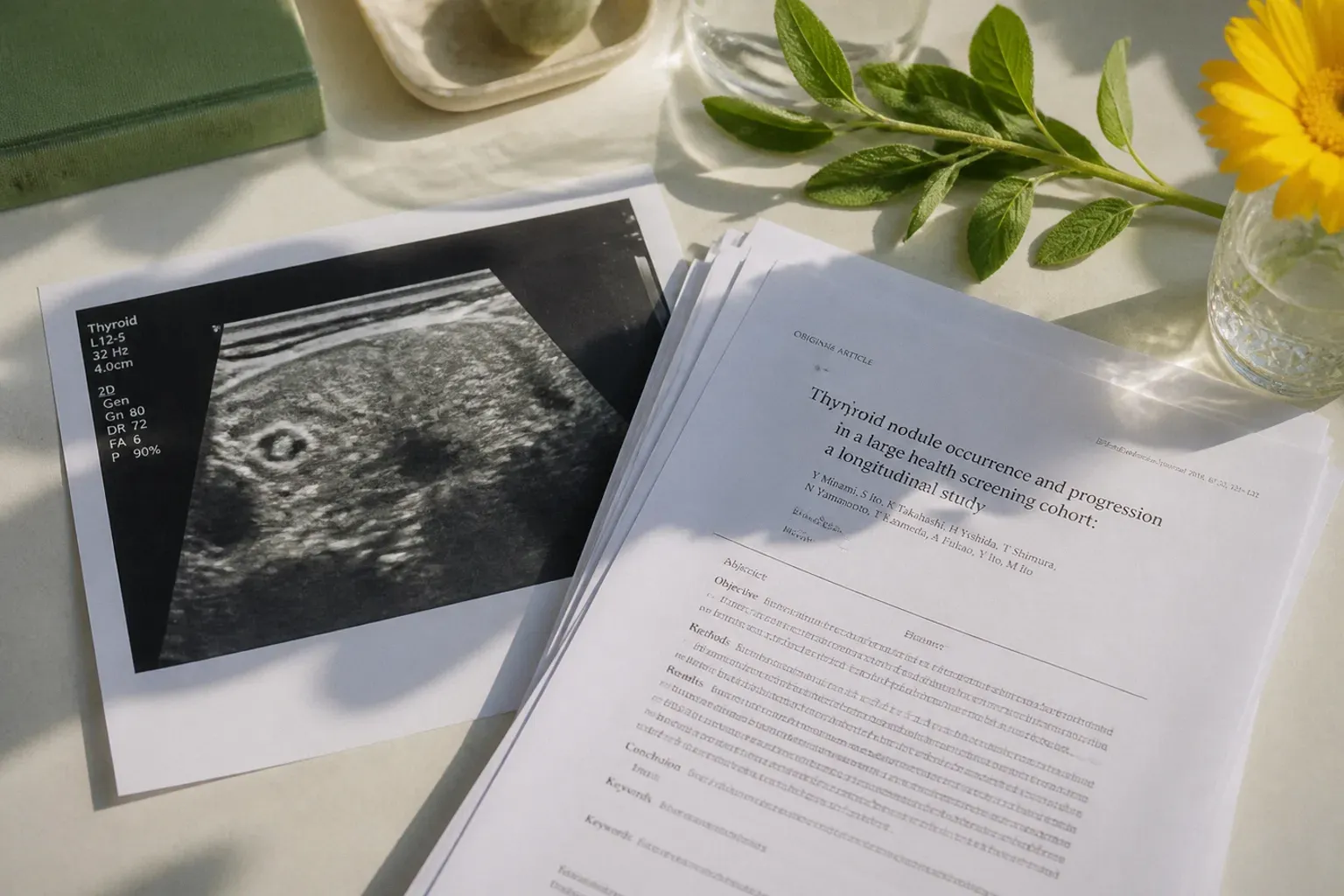
Do GLP-1 medicines cause thyroid cancer? The honest answer is that it has not been shown in people. The thyroid cancer risk on the label comes from rodent studies. The human data split: one French study found a higher rate of thyroid cancer after 1 to 3 years of use, while the larger Scandinavian and US cohorts found no increase, and pooled trials are too small to settle it.
The question matters because the warning sits in a black box at the top of the prescribing information for semaglutide, tirzepatide, liraglutide and dulaglutide, and it is often the first thing people read. It also matters because thyroid cancer is rare, which makes it hard to study. A drug can be taken by hundreds of thousands of people before a study collects enough cases to say anything with confidence.
This article walks through what the boxed warning says, what the French case-control study found, what the Scandinavian and US cohort studies found, what the LEADER trial measured in calcitonin levels, and what three meta-analyses of randomized trials concluded. It ends with what none of this research has tested: low and microdose regimens.
Key Takeaways
- The Wegovy label states that semaglutide causes thyroid C-cell tumors in rodents and that it is unknown whether it causes them, including medullary thyroid carcinoma, in humans.
- A French case-control study of 2,562 thyroid cancer cases found GLP-1 receptor agonist use for 1 to 3 years linked to higher risk of all thyroid cancer (adjusted hazard ratio 1.58).
- The French and US cohort studies and the LEADER trial enrolled people with type 2 diabetes, and the Scandinavian study compared GLP-1 users with users of other diabetes drugs, so there is less direct evidence in people taking GLP-1 drugs for weight alone.
- A Scandinavian cohort of 145,410 GLP-1 users found no increase compared with DPP4 inhibitor users (hazard ratio 0.93), with thyroid cancer rates of 1.33 and 1.46 per 10,000 person-years.
- A 2025 study of 460,032 US GLP-1 users found no increased risk of thyroid tumors against three other diabetes drug classes.
- A 2026 meta-analysis of 48 randomized trials and 94,245 people rated the effect on thyroid cancer as probably little or none, at 1 fewer to 9 more cases per 10,000 treated.
What does the GLP-1 thyroid cancer boxed warning actually say?
Wegovy prescribing information, U.S. Food and Drug Administration
The boxed warning says the thyroid tumors were seen in rodents and that their relevance to people is unknown. The Wegovy label states that semaglutide causes thyroid C-cell tumors in rodents at clinically relevant exposures, and that it is unknown whether Wegovy causes C-cell tumors, including medullary thyroid carcinoma, in humans, because the human relevance of the rodent tumors has not been determined.
The label turns that uncertainty into one firm rule. Wegovy is contraindicated in anyone with a personal or family history of medullary thyroid carcinoma or with multiple endocrine neoplasia syndrome type 2, an inherited condition that raises the chance of that cancer. Prescribers are asked to counsel patients about the potential risk and about the symptoms of thyroid tumors.
The warning is about C-cells, which make the hormone calcitonin, and about medullary thyroid carcinoma, which starts in those cells. Several of the studies below report medullary cancer separately from all thyroid cancer for that reason. Our article on GLP-1 medicines, levothyroxine and TSH covers how these drugs interact with thyroid hormone treatment.
Thyroid Cancer Estimates Across Six Analyses
Hazard ratio or odds ratio for all thyroid cancer, GLP-1 drug versus comparator. Above 1 means more cases on the GLP-1 drug. Only the French result and the Silverii pooled estimate reached statistical significance.
Bezin, Diabetes Care, 2023; Pasternak, BMJ, 2024; Silverii, Diabetes Obes Metab, 2024; Ko, Ann Intern Med, 2026; Eisa and Barood, AACE Endocrinol Diabetes, 2026.
What did the French GLP-1 thyroid cancer study find?
Bezin and colleagues, Diabetes Care, 2023
The French study found a higher risk of thyroid cancer in people who had used a GLP-1 receptor agonist for 1 to 3 years. Bezin and colleagues used the French national health insurance database (SNDS) and took people with type 2 diabetes on second-line diabetes drugs between 2006 and 2018. Thyroid cancers diagnosed between 2014 and 2018 were the cases, and each was matched with up to 20 controls by age, sex and length of diabetes.
The study compared 2,562 people with thyroid cancer against 45,184 controls. GLP-1 use for 1 to 3 years was associated with a higher risk of all thyroid cancer (adjusted hazard ratio 1.58, 95% CI 1.27 to 1.95) and of medullary thyroid cancer (adjusted hazard ratio 1.78, 95% CI 1.04 to 3.05). Exposure was measured over the 6 years before diagnosis, with a 6-month lag to avoid counting drug started after a tumor was already growing.
A case-control study can show an association but cannot prove the drug caused the cancers. One common concern with designs like this is detection: people newly started on a drug often see their doctor more, which can turn up small thyroid nodules that would otherwise go unnoticed. The study adjusted for goiter and other thyroid conditions, but it could not measure how often each person had a neck exam or scan.
Did the Scandinavian cohort find more thyroid cancer on GLP-1 drugs?
Pasternak and colleagues, BMJ, 2024
No. The Scandinavian cohort study found no increase in thyroid cancer among people starting a GLP-1 receptor agonist. Pasternak and colleagues used nationwide registers in Denmark, Norway and Sweden from 2007 to 2021 and compared 145,410 people who started a GLP-1 drug with 291,667 who started a DPP4 inhibitor, another class of diabetes medicine.
Thyroid cancer developed in 76 people on GLP-1 drugs and 184 on DPP4 inhibitors, rates of 1.33 and 1.46 per 10,000 person-years. The hazard ratio was 0.93 (95% CI 0.66 to 1.31). Against SGLT2 inhibitors the hazard ratio was 1.16 (0.65 to 2.05), also not significant. For medullary thyroid cancer the estimate was 1.19, with a confidence interval running from 0.37 to 3.86 because there were so few cases.
The authors were precise about what that rules out. The upper end of the confidence interval was consistent with no more than a 31% increase in relative risk. Mean follow-up on GLP-1 drugs was 3.9 years, so the study cannot speak to risks that might appear only after a decade of use.
Thyroid Cancer Rates in the Scandinavian Cohort
New thyroid cancer cases per 10,000 person-years in Denmark, Norway and Sweden.
Pasternak B et al. BMJ, 2024. 145,410 GLP-1 users and 291,667 DPP4 inhibitor users, 2007 to 2021.
What do the large US studies show about GLP-1 drugs and thyroid tumors?
Morales and colleagues, Diabetes Care, 2025; Acheampong and colleagues, BMJ Open Diabetes Research & Care, 2025
The largest US analyses found no increased risk. Morales and colleagues included 460,032 people with type 2 diabetes who started a GLP-1 receptor agonist after metformin and compared them with new users of SGLT2 inhibitors, DPP-4 inhibitors and sulfonylureas. Only the US databases passed the study's quality checks. Thyroid tumors occurred at 0.88 to 1.03 per 1,000 person-years in the GLP-1 groups, and the risk was not higher than with any of the three comparison drugs.
A separate study of 73,388 older Medicare beneficiaries, average age 72.4, compared GLP-1 drugs with SGLT2 inhibitors. Over 3 years the adjusted risk difference for thyroid cancer was -23 per 10,000 (95% CI -51 to 4), so no increase. The authors framed it carefully: the finding offers reassurance for short-term use but does not eliminate the possibility of long-term or subtype-specific risks. Median treatment in that study was only 0.82 to 1.15 years.
How Many People Each Study Included
GLP-1 users in the Morales and Pasternak cohorts; all new users in the Medicare GLP-1 versus SGLT2 comparison; total participants in the trials.
Morales, Diabetes Care, 2025; Pasternak, BMJ, 2024; Ko, Ann Intern Med, 2026; Eisa and Barood, 2026; Acheampong, BMJ Open Diabetes Res Care, 2025; Hegedüs, Diabetes Care, 2018.
Does liraglutide raise calcitonin levels in people?
Hegedüs and colleagues, Diabetes Care, 2018 (LEADER trial)
In the LEADER trial, liraglutide did not raise calcitonin. Calcitonin is the hormone C-cells release, so a rise would be an early sign that the rodent finding was playing out in people. LEADER randomized 9,340 people with type 2 diabetes and high cardiovascular risk to liraglutide or placebo and followed them for 3.5 to 5 years.
At 36 months the estimated treatment ratio for calcitonin was 1.03 in men and 1.00 in women, meaning no meaningful difference from placebo. There were no cases of C-cell hyperplasia or medullary thyroid carcinoma in the liraglutide group. LEADER tested liraglutide only, so the result does not automatically carry over to semaglutide or tirzepatide.
What about medullary thyroid cancer specifically?
The cancer the boxed warning names
The medullary thyroid cancer data are too thin to give a clear answer. The French study reported an adjusted hazard ratio of 1.78, just significant. The Scandinavian cohort reported 1.19 with a confidence interval from 0.37 to 3.86, and a 2024 meta-analysis of trials reported an odds ratio of 1.44 with an interval from 0.23 to 9.16.
Intervals that wide mean the true effect could be a reduction, no change or a sizeable increase. Medullary cancer is uncommon, and no study so far has collected enough cases to narrow it down. That uncertainty is the reason the contraindication for people with a personal or family history stays in place.
Medullary Thyroid Cancer Estimates
Point estimates only. The Scandinavian interval ran from 0.37 to 3.86 and the trial interval from 0.23 to 9.16, so neither rules out no effect.
Bezin, Diabetes Care, 2023; Pasternak, BMJ, 2024; Silverii, Diabetes Obes Metab, 2024.
Do randomized trials show more thyroid cancer on GLP-1 medicines?
Silverii, 2024; Ko, Annals of Internal Medicine, 2026; Eisa and Barood, 2026
The trial data lean slightly toward more cases but are imprecise, because so few thyroid cancers occur. A 2024 meta-analysis by Silverii and colleagues took 64 trials lasting at least 52 weeks and found an odds ratio of 1.52 (95% CI 1.01 to 2.29). That just crossed the line for significance, and the fragility index was 1, meaning a single case going the other way would have erased it. The authors put the 5-year number needed to harm at 1349.
The largest pooled analysis came later. Ko and colleagues, in Annals of Internal Medicine in 2026, combined 48 placebo-controlled trials with 94,245 participants and concluded that GLP-1 drugs probably have little or no effect on thyroid cancer (odds ratio 1.37, 95% CI 0.82 to 2.31), at moderate certainty. In absolute terms that ranged from 1 fewer to 9 more cases per 10,000 people treated.
A third 2026 analysis by Eisa and Barood pooled 15 trials and 84,237 participants. It counted 28 thyroid cancers in the incretin groups and 15 in the control groups, an odds ratio of 1.52 (0.86 to 2.68) that was not significant. The authors rated the certainty very low and said limited follow-up and imprecision prevent ruling out a clinically relevant increase.
Thyroid Cancer Cases Across 15 Randomized Trials
Total thyroid cancer events among 84,237 participants. Small counts like these are why the pooled estimates have wide intervals.
- Thyroid cancer events
Eisa N, Barood O. AACE Endocrinology and Diabetes, 2026. Trials of at least 26 weeks; odds ratio 1.52 (0.86 to 2.68), very low certainty.
Is the thyroid cancer risk different for tirzepatide?
What the pooled trials can and cannot separate
The trial data do not show a difference. Ko and colleagues reported that their results were consistent in trials of semaglutide or tirzepatide, and across subgroups by dose and follow-up length. That is reassuring as far as it goes, but the trials were not designed to measure cancer and had short follow-up, which the authors listed as the main limitation.
Tirzepatide is the newest of these drugs, so most of the observational data, including the French and Scandinavian studies, come from earlier GLP-1 medicines such as liraglutide. For a broader look at what long-term use is known to involve, see our article on long-term GLP-1 use.
Should you have a thyroid scan or calcitonin test before starting a GLP-1?
What the label recommends
Routine screening is not recommended by the label. The Wegovy prescribing information says routine monitoring of serum calcitonin or thyroid ultrasound is of uncertain value for early detection of medullary thyroid carcinoma. Testing everyone would also find many harmless nodules, which can lead to biopsies and worry without a clear benefit.
What the label does ask for is a family history and attention to symptoms. The symptoms it lists for patients to know are a mass in the neck, trouble swallowing (dysphagia), shortness of breath (dyspnea) and persistent hoarseness. Anyone with a relative who had medullary thyroid carcinoma or multiple endocrine neoplasia type 2 should raise it before a first prescription, because that history rules these drugs out.
Does a GLP-1 microdose change the thyroid cancer question?
What has not been studied
No study has looked at thyroid cancer risk on a GLP-1 microdose. The cohorts above grouped people by whether they started a GLP-1 drug at prescribed doses, and the trials used standard doses. None reported results for low-dose or microdose regimens, so any claim that a smaller dose is safer for the thyroid goes beyond the evidence.
The contraindication is also dose-independent. It is written against the drug, not an amount of it, so a microdose does not make these medicines appropriate for someone with a personal or family history of medullary thyroid carcinoma or multiple endocrine neoplasia type 2. Other label warnings work the same way; our article on pancreatitis and GLP-1 medicines covers another.
Frequently Asked Questions
References
- U.S. Food and Drug Administration. WEGOVY (semaglutide) injection, for subcutaneous use. Highlights of Prescribing Information, 2025. accessdata.fda.gov
- Bezin J, Gouverneur A, Pénichon M, et al. GLP-1 Receptor Agonists and the Risk of Thyroid Cancer. Diabetes Care, 2023. doi:10.2337/dc22-1148
- Pasternak B, Wintzell V, Hviid A, et al. Glucagon-like peptide 1 receptor agonist use and risk of thyroid cancer: Scandinavian cohort study. BMJ, 2024. doi:10.1136/bmj-2023-078225
- Morales DR, Bu F, et al. Risk of Thyroid Tumors With GLP-1 Receptor Agonists: A Retrospective Cohort Study. Diabetes Care, 2025. doi:10.2337/dc25-0154
- Acheampong CO, Buse JB, et al. Investigating the association between incretin-based therapies and thyroid cancer incidence among US Medicare beneficiaries with diabetes. BMJ Open Diabetes Research & Care, 2025. doi:10.1136/bmjdrc-2025-005090
- Hegedüs L, Sherman SI, Tuttle RM, et al. No Evidence of Increase in Calcitonin Concentrations or Development of C-Cell Malignancy in Response to Liraglutide for Up to 5 Years in the LEADER Trial. Diabetes Care, 2018. doi:10.2337/dc17-1956
- Silverii GA, Monami M, et al. Glucagon-like peptide-1 receptor agonists and risk of thyroid cancer: A systematic review and meta-analysis of randomized controlled trials. Diabetes, Obesity and Metabolism, 2024. doi:10.1111/dom.15382
- Ko A, Chang YC, Bahar F, et al. Risk for Cancer With Glucagon-Like Peptide-1 Receptor Agonists and Dual Agonists: A Systematic Review and Meta-analysis. Annals of Internal Medicine, 2026. doi:10.7326/ANNALS-25-02237
- Eisa N, Barood O. Incretin-Based Therapy and Thyroid Cancer Risk: A Systematic Review and Meta-Analysis of Randomized Controlled Trials. AACE Endocrinology and Diabetes, 2026. doi:10.1016/j.aed.2026.03.003
This article is for general educational purposes only and does not constitute medical advice or a recommendation to start, stop or change any medication. Semaglutide, tirzepatide, liraglutide, dulaglutide and other GLP-1 receptor agonists are prescription medicines that carry a boxed warning about thyroid C-cell tumors and are contraindicated in anyone with a personal or family history of medullary thyroid carcinoma or multiple endocrine neoplasia syndrome type 2. Microdose regimens are not an FDA-approved way of using GLP-1 drugs and have not been studied for thyroid safety. Report a neck lump, trouble swallowing, persistent hoarseness or shortness of breath to a clinician. Nothing here is intended to diagnose, prevent, treat, or cure any condition.
Smaller Doses. Sharper Protocols.
Metabolic health you can measure, built around a dose designed to work with your body rather than against it.
Find Your Protocol